

















In the first volume, the reader discovered that a man had been sentenced to death. for attempting to assassinate Hitler but, ten years later, a duo of journalists revived the investigation. The shadow side then raises this question: can we assassinate a dictator ?
Further investigation
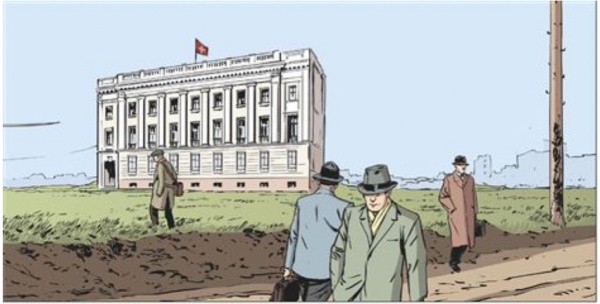 The first volume of La part de l'ombre allowed us to discover Maurice Bavaud, executed in 1941 for trying to kill Hitler. According to the Nazi thesis, Bavaud is a religious fanatic who acted alone. But the scenario is more complex because the reader followed in parallel in 1955 in East Berlin the young apprentice reporter Wolf Fiala and Guntram Muller. The latter is a former Nazi policeman who seeks to survive in the complex world of post-war Germany. Disillusioned and cynical, he changed by confronting Bavaud's idealism and decided to rehabilitate him.But his editor, urged by the communist authorities, entrusted him with the responsibility of interviewing Nikita Khrushchev, First Secretary of the Communist Party. Personal quest and geopolitical change will intersect in the streets of Berlin. This second volume extends the narrative threads of the first making The Shadow Share a fascinating spy story. Screenwriter Pat Perna enriches the psychology of the main characters. Fiala less disinterested than it seems. Guntram Muller is personally involved in this affair because, if he no longer has ambition, this tired man still holds on to his honor. New revelations about his past show that this character is even more murky. Maurive Bavaud's brother wrote an afterword thanking the authors for their commitment. Perna conveys a message in The Shadow Side. He denounced the false Swiss neutrality during the Second World War that allowed him to save his banks from the Nazis and reprisals from the Allies. The screenwriter also gives a new image of the Nazis. It demonstrates their violence and fanatical anti-Semitism but, for all that, the Nazis do not form a united bloc. The Gestapo, the army and the Abwehr competed for Hitler's favor. In the same way, Americans are certainly defenders of democracy, but an agent is a brute without culture.
The Next War
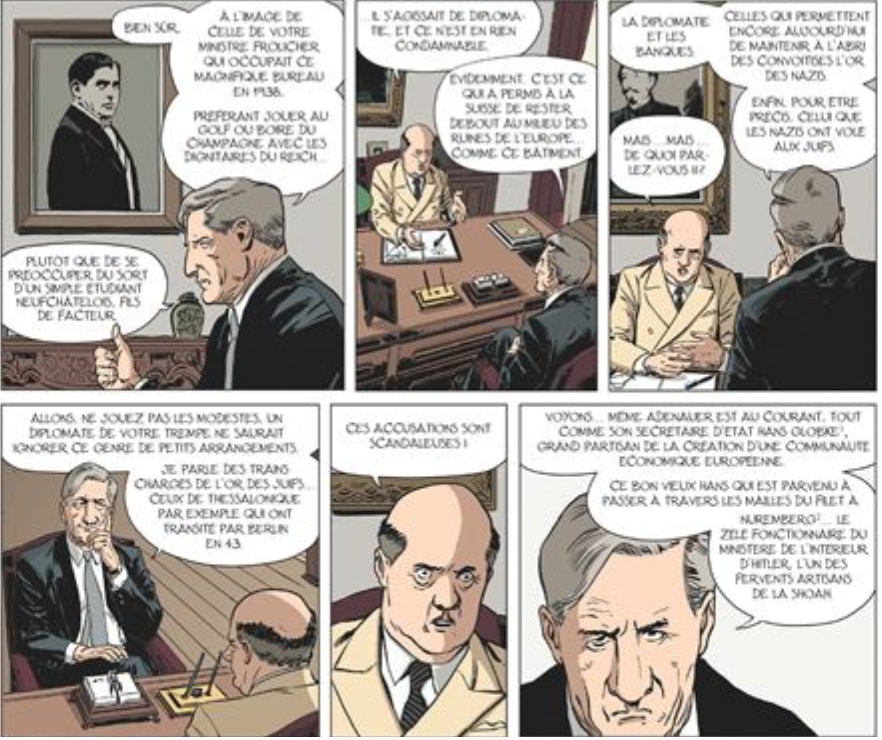 The sequel to La part de l'ombre focuses on the 1950s. We then discover the complexity of this new war by the character of Guntram Muller. Living in East Berlin, he has to pay attention to the Soviet authorities who know his shameful past. Stasi spies, the East German political police, are everywhere… and sometimes very close. But Muller helps the U.S. secret services. It is the symbol of a war that does not say its name and uses espionage to know, influence and prepare for the next world conflict. This is why the former Nazis are not hunted down but used by the great powers. Yet it remains a sign of hope because Khrushchev is preparing to officially criticize Stalin's policies and thus launch the policy of openness with the Western bloc. Francisco Ruizge brings his talent to highlight the story. He perfectly transcribes the streets of Berlin with period storefronts and propaganda posters. He plays on the frame to mark the two time periods: black for the 30s and white for the 50s. Through his talent, one enters the Kehlsteinhaus, Hitler's residence in the Alps. Published by Glénat, La part de l'ombre is a historical diptych on the most advanced attack against Hitler but also a testimony to the complexity of the world born in 1945. Perna and Ruizge form a powerful duo to immerse the reader in the past and in the thoughts of the characters. The world of 1955 is as dark as the motivations of men. You can find other historical chronicles on the site like # J'accuse… ! and The Warsaw Insurgent.